The AI-Enabled Field Sales Force
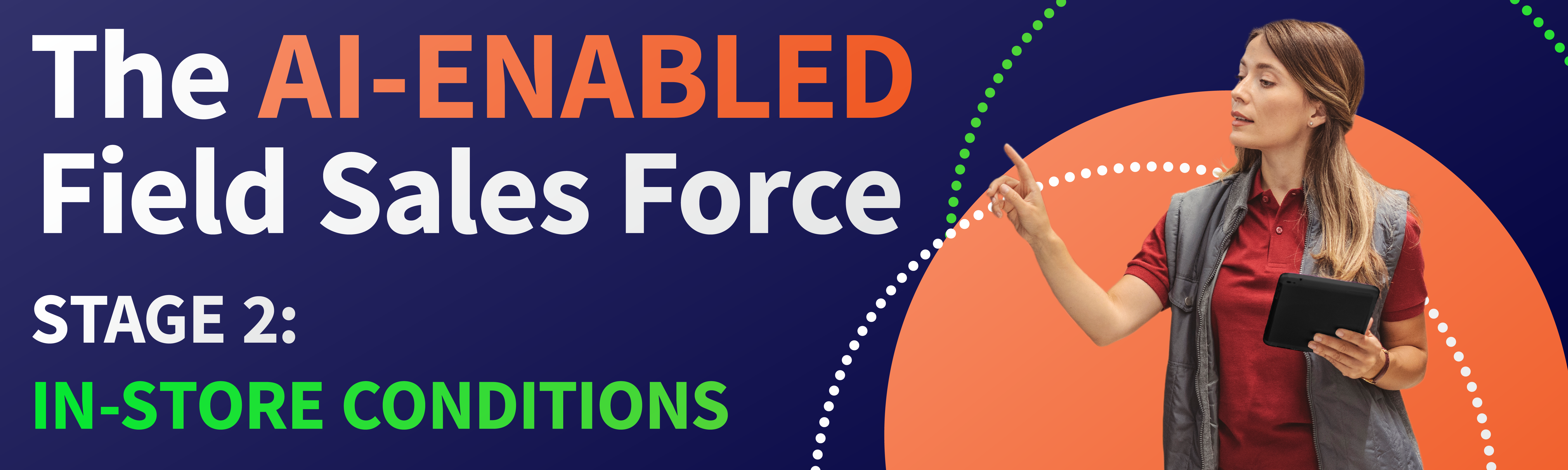
Stage 2: In-Store Conditions
The shelf in your data and the shelf in the store are not the same shelf
By Sam Barclay, Chief Growth Officer, StayinFront
The Process, Briefly
The StayinFront Retail Optimization Platform runs field sales enablement as five connected stages. Opportunity quantifies the Size of Prize in every outlet for every SKU and routes the representative dynamically to the right store at the right time. In-Store Conditions captures what is actually on the shelf. Coach converts that into a recommended action with a reason attached. Pitch turns the action into a buyer-specific conversation and an order. Measure and Goal Set proves the ROI of every recommendation and resets goals at store, representative and route level.
The loop closes: measurement refines the models that calculate opportunity. This post is about stage two, the stage where ambition meets the actual shelf.
Your Beautiful Model Has a Reality Problem
Every AI recommendation engine in consumer goods rests on an assumption that is almost always wrong: that the state of the store in the system matches the state of the store in the world.
It does not. A promotion ran and the display came down early. A competitor took two facings during a reset. Three SKUs are out of stock but showing as in-stock because the phantom inventory has not cleared. The planogram in the system is version 4; the shelf is running version 2 because the store never executed the reset.
If your Size of Prize is calculated on the first shelf and your representative is standing in front of the second, your recommendation is confidently, precisely wrong. A representative who receives three confidently wrong recommendations stops opening the app. Adoption dies quietly, and nobody logs a ticket about it.
This is why the In-Store Conditions stage works as a truth-reconciliation step rather than a data-capture step. The platform creates a realogram of the shelf or secondary location, measures on-shelf availability, share of shelf and quality of shelf instantly, and re-prioritizes Next Best Actions against what is actually there and the value of each available action.
The word that matters most here is instantly. Insight that arrives after the representative has left the store is a report. Insight that arrives while the representative is standing at the shelf is a decision.
The Friction Nobody Budgets For
Here is where most image recognition programs fail, and it has nothing to do with the algorithm.
They fail because the capture process costs the representative more time than the insight saves them. Representatives are rational actors under time pressure. If a workflow adds six minutes to a forty-minute call, they will find a way around it, and no amount of head-office mandate will hold for long.
Image Recognition technology should deliver results in under 10 seconds. If yours does not, it is an after-the-fact reporting tool rather than a source of real-time insights.
A major ice cream manufacturer with a long-standing StayinFront TouchCG® deployment ran headlong into exactly this. The manufacturer needed representatives to identify out-of-stocks, confirm new products were on shelf, and capture better freezer data. The original workflow required opening freezer doors and working through StayinFront Shelf Builder. Field users judged it too time-consuming, and the pilot nearly failed.
What happened next is the part worth your attention. StayinFront did not push harder on adoption. The team went back to the field, listened, and rebuilt the workflow: photo capture was enabled through the freezer glass, StayinFront Shelf Builder was separated from StayinFront On-Device AI image recognition, and recognition results were routed directly into the audit grid so the data landed where the representative was already working.
In the end, a pilot that nearly died moved into deployment, with about 130 field users live. Scope expanded from a selected set of premium ice cream products to the full ice cream range plus competitive products: around 145 customer SKUs and 90 competitive SKUs. Recognition accuracy through glass, where product is visible, runs in the high 90s. Representatives reported through survey that the revised process is faster. Head office now also receives facings counts and planogram data it simply never had before.
Two business benefits sit inside that story, and they are different in kind.
The first is speed at the shelf: capture that costs the representative less time than it returns. That is what protects adoption, and adoption is what protects every other stage of the process.
The second is data that did not previously exist. The customer’s home office gained facings and planogram visibility that no manual audit process was ever going to deliver at scale. New data creates new decisions. You cannot optimize share of shelf if you have never measured it.
A leading global snack maker in Canada offers a quieter version of the same lesson. A StayinFront team member observed a representative in store (an ordinary ride-along in a field organization of roughly 170 representatives and 15 head office users) and noticed something the home office had never flagged. Representatives were tracking in-store display assets across emails, spreadsheets, tablets and manual processes. Twice a year, each representative spent half a day to a full day completing an asset spreadsheet that was obsolete within about three weeks.
Adding asset capture (location, type, condition, with banner-level reporting) into the normal store visit turned a twice-yearly fiction into near-real-time visibility. The value is self-evident to field and head office simultaneously. The benefits included avoided reordering of assets that already existed, faster redeployment of assets sitting in the wrong place, and representatives freed from juggling multiple tools and devices.
No one wrote a business case for that. It came from watching a representative work.
The Question Worth Sitting With
When was the last time someone from your commercial or IT leadership team spent a full day in-store, watching a representative use your systems end to end, without intervening?
If the answer is “not this year,” you are making investment decisions about field execution based on a description of the field rather than the field itself. The freezer pilot was recovered because someone went and looked. The display-asset opportunity existed because someone went and looked.
Where This Leaves You
The In-Store Conditions stage does two jobs. It grounds your AI in reality so the recommendations that follow are worth acting on. It also generates a stream of shelf-level data (OSA, share of shelf, quality of shelf, realograms, assets) that becomes the raw material for measurement in stage five.
However, it only works if capture is faster than the alternative. Design for the representative’s forty minutes, or the rest of the platform never gets used.
Next in the series is Coach, covering why an alert is not an action and what the difference is worth.
Sam Barclay is Chief Growth Officer at StayinFront. If your image recognition program is stalling on field adoption rather than accuracy, we have seen that film before, and we know how it ends well. Get in touch.
Know More. Do More. Sell More.